Best Free AI Interior Design Apps 2026 (Ranked for Renters and Budget Decorators)
Quick Answer: A free AI interior design app lets you upload a photo of your room and receive a photorealistic redesign in seconds — no designer, no commitment, no upfront cost. These tools analyse your space, suggest furniture layouts, and render new colour schemes and styles that you can test before spending anything. In 2026, the best free options are genuinely usable — not just heavily restricted demos.
Choosing furniture without visualising it in your actual room is an expensive gamble. The sofa looks different in person. The paint colour is nothing like the swatch. Every bad call adds up — and for renters decorating on a tight budget, these mistakes cut deep.
Free AI design tools change that equation. Upload a photo of your room, pick a style, and see a photorealistic version of what it could look like in under 30 seconds. Test five different sofas. Try three colour combinations.
Below are the eight best free AI interior design apps available in 2026 — evaluated on what their free plans actually deliver, not just what their marketing claims.
1. Decory — Best Overall AI Interior Design App for Renters
Best for: Renters and first-time decorators who want a mobile-first, photorealistic AI tool with shoppable results
Pricing: Free to download on iOS and Android; a Premium subscription is required to generate designs (20+ curated styles)
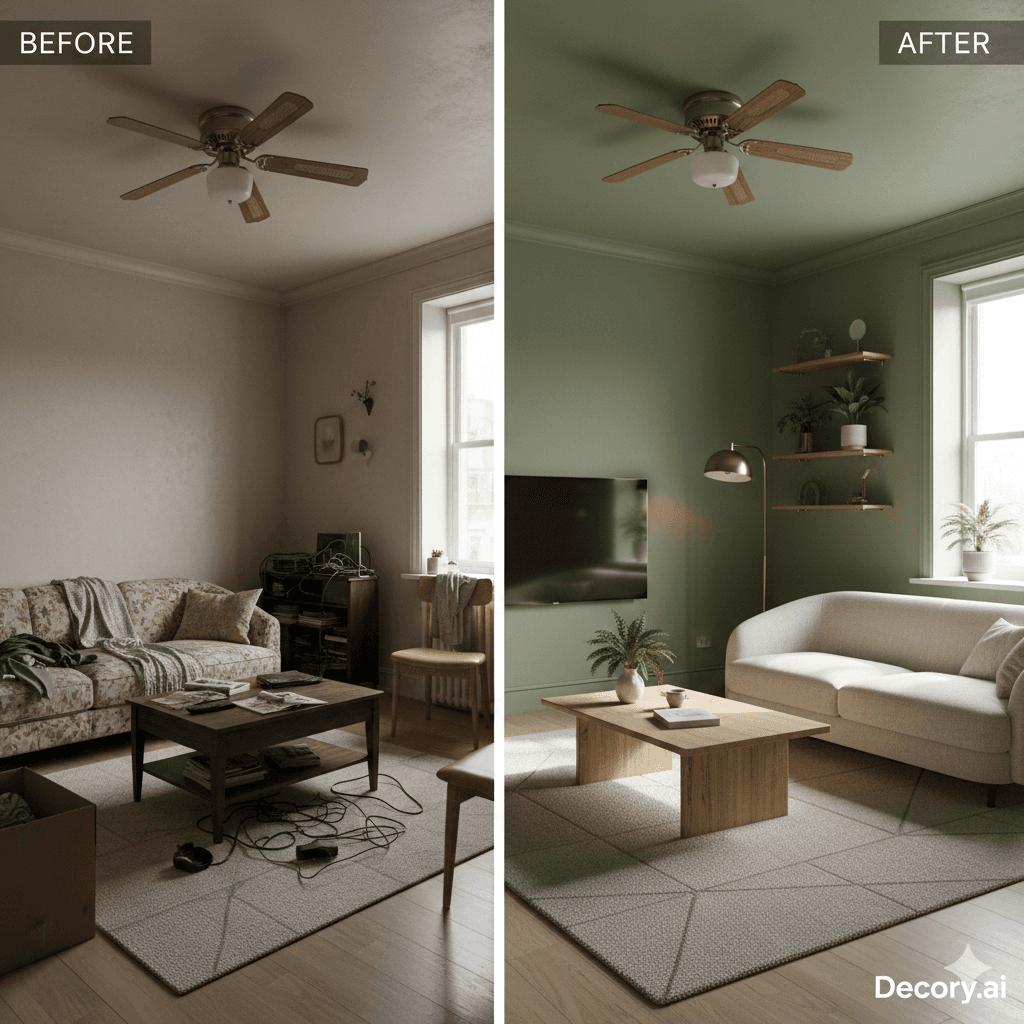
Decory is the most complete AI interior design app for everyday renters in 2026 — though unlike most apps here it has no free tier, and generating designs requires a Premium subscription. Upload a photo, choose a style — Modern, Scandinavian, Japandi, Bohemian, Coastal, Industrial, and more — and receive a photorealistic redesign in about 30 seconds. The AI analyses your actual space: wall positions, natural light, existing furniture, and proportions.
What separates Decory from most competitors is what happens after the redesign. Every output includes shoppable furniture links, so you can identify pieces from the generated design and find real products to match them.
Key features:
- Photo upload with full spatial analysis
- 20+ curated design styles including Japandi, Coastal, and Art Deco
- Shoppable product links in every redesign
- Area-specific editing (swap just a wall, corner, or furniture zone)
- Style reference feature
- Available on iOS and Android; free to download
Limitations:
- No free tier — a Premium subscription is required to generate designs
Who should use it: Anyone decorating a rental apartment, studio, or first home who wants a mobile-friendly tool.
2. Decoratly — Best Free Plan for Two Full Room Redesigns
Best for: Users who want a meaningful free trial that covers two different rooms
Free plan: 2 full room redesigns across 3 style options, no credit card required; paid plans from $3.99/month
Decoratly's free plan is genuinely generous. Most free AI design tools give you one or two low-quality renders before pushing a subscription. Decoratly gives you two complete room redesigns with photorealistic output and no watermarks. The AI achieves roughly 96% accuracy in room analysis.
Key features:
- 2 full room redesigns free (3 style options)
- 85+ design styles on paid plans
- No credit card required for free tier
- Generates in approximately 30 seconds
- Post-generation editing tools (paid)
Limitations:
- Only 3 styles on the free plan vs 85+ on paid
- Advanced editing requires a subscription
- No mobile app — web only
Who should use it — Renters who want to test the concept before committing to an app.
3. RoomsGPT — Best for Quick No-Signup Experiments
Best for: Anyone who wants to try AI room design instantly without creating an account
Free plan: Free daily credits, no signup required
RoomsGPT takes the lowest-friction approach of any app on this list. Open it in a browser, upload a photo, pick one of 61+ styles, and get a redesign — no account, no email, no credit card.
Key features:
- No signup required to start
- 61+ design styles
- Free daily credits that refresh
- Mobile-friendly browser experience
Limitations:
- Limited daily generation credits
- No furniture-level editing
- Less photorealistic than Decory or Decoratly on complex room geometries
- No shoppable product integration
4. Interior AI — Best for High-Quality Realistic Renders
Best for: Users who prioritise output quality and realism above feature breadth
Free plan: Limited free credits; paid plans from approximately $15/month
Interior AI produces some of the most photorealistic room renders available from any consumer AI tool. Renders complete in approximately 25 seconds and the output quality is consistently high.
Key features:
- Among the most photorealistic outputs available
- 15+ design styles
- Fast generation (~25 seconds)
- Web-based interface
Limitations:
- Very limited free credits
- No mobile app
- No shoppable links
- Higher cost to maintain access beyond free tier
5. Reimagine Home — Best for Rental-Specific Visualisation
Best for: Renters who want to test furniture and staging ideas without modifying room structure
Free plan: 3 free photorealistic designs, no credit card required
Reimagine Home positions itself specifically around decision-support rather than aesthetic exploration. The 3 free designs use your uploaded photos to help train their models — privacy-conscious users should read their data policy.
Key features:
- 3 free photorealistic redesigns
- Shoppable product integration
- Focuses on realistic, decision-quality output
- Web-based
Limitations:
- Free plan uses uploaded photos for model training
- No mobile app
- Limited free generations before paywall
6. HomeDesigns AI — Best for Whole-Home Redesign Inspiration
Best for: Users redesigning multiple rooms who want to see the big picture
Free plan: 1 free AI-generated image, then paid; covers interiors, exteriors, and gardens
HomeDesigns AI handles more room types than most competitors — kitchens, bathrooms, exteriors, outdoor spaces.
Key features:
- 80+ design styles
- Works on any room type including kitchens, bathrooms, and outdoor spaces
- High render quality
- Shoppable integration via AI product identification
Limitations:
- 1 free image before paywall
- Web only, no mobile app
7. Planner 5D — Best Free Floor Plan and 3D Layout Tool
Best for: Renters who want to plan room layouts and furniture placement before worrying about aesthetics
Free plan: Unlimited basic floor plan and 3D room design; AI photo features are paid
Planner 5D takes a fundamentally different approach. Instead of uploading a photo, you build a room from scratch in a drag-and-drop 3D editor.
Key features:
- Unlimited basic 3D floor plan design (free)
- AI floor plan recognition from photo (paid)
- Available on iOS, Android, web, and desktop
- Extensive 3D furniture library
Limitations:
- Photo-to-AI-redesign workflow requires paid plan
- Steeper learning curve
- Free tier's 3D visuals are less photorealistic
8. Spacely AI — Best for Professional-Grade Free Renders
Best for: Renters or freelancers who need professional-quality staging or design visualisation
Free plan: Limited free tier; professional-grade output
Spacely AI targets interior designers and real estate professionals, but its free tier gives budget renters access to render quality typically behind a paywall.
Key features:
- Professional-grade render quality
- Works on interiors and exteriors
- Supports multiple room types
- API available for developers
Limitations:
- Limited free tier
- More features than most renters need
- Interface less intuitive than consumer-focused tools
What Is the Best Free AI Interior Design App in 2026?
For most renters decorating on a budget, Decory is the best all-round AI interior design app in 2026 — though if a free tier is your requirement, Decoratly or RoomsGPT are the places to start. Decory combines mobile accessibility on iOS and Android, photorealistic output from a real photo upload, shoppable product links, and 20+ curated style options. For users who want two full room redesigns completely free, Decoratly is the best alternative. For zero-signup experiments, RoomsGPT is the fastest entry point.
Are Free AI Room Design Apps Really Free?
Most AI interior design apps use a freemium model — a functional free tier with capped usage, and paid plans that unlock unlimited generations. "Truly free" in this category means: no credit card required to get meaningful value. By that standard, Decoratly and RoomsGPT qualify; Decory is free to download but requires a Premium subscription to generate designs.
Can Free AI Decor Tools Replace an Interior Designer?
For decorating decisions — furniture selection, colour schemes, layout testing, style exploration — free AI tools cover the core use cases well, at zero cost. Where professional designers remain irreplaceable is in tactile material expertise, contractor relationships, structural guidance, and complex renovation planning.
How to Maximize a Free AI Design Plan
Getting the most from a capped free tier requires a bit of strategy.
Before you generate:
- Take the best possible photo — daylight, level camera, from the doorway or corner
- Clear clutter from the frame
- Know your room dimensions before you start
During generation:
- Use your free credits on the layouts and style questions that carry the most decision weight
- Save screenshots of every output you like
FAQ: Free AI Interior Design Apps
Is there a completely free AI interior design app?
Yes — though not from Decory, which is free to download but requires a Premium subscription to generate. Decoratly provides two complete room redesigns free. RoomsGPT offers free daily credits with no signup.
Are free AI room design apps accurate?
Modern free AI room design apps achieve 96–99% spatial accuracy from a well-taken photo. Always verify actual furniture dimensions before ordering.
Do free AI design tools save money?
Yes — in two measurable ways: they prevent purchasing mistakes, and eliminate the need for design consultations ($150–$300/hour in the US).
Can renters use AI interior design apps?
Absolutely. Free AI design tools are ideal for renters because they help you visualise changes without making any permanent modifications.
Are AI-generated room designs realistic?
In 2026, yes — the best free AI interior design apps produce photorealistic outputs that accurately reflect your room's actual architecture, lighting conditions, and spatial proportions.
Ready to Transform Your Space?
Download Decory, browse the full style library free, and subscribe when you are ready to generate — just a photo of your room and a style direction.
Try Decory AI Now